
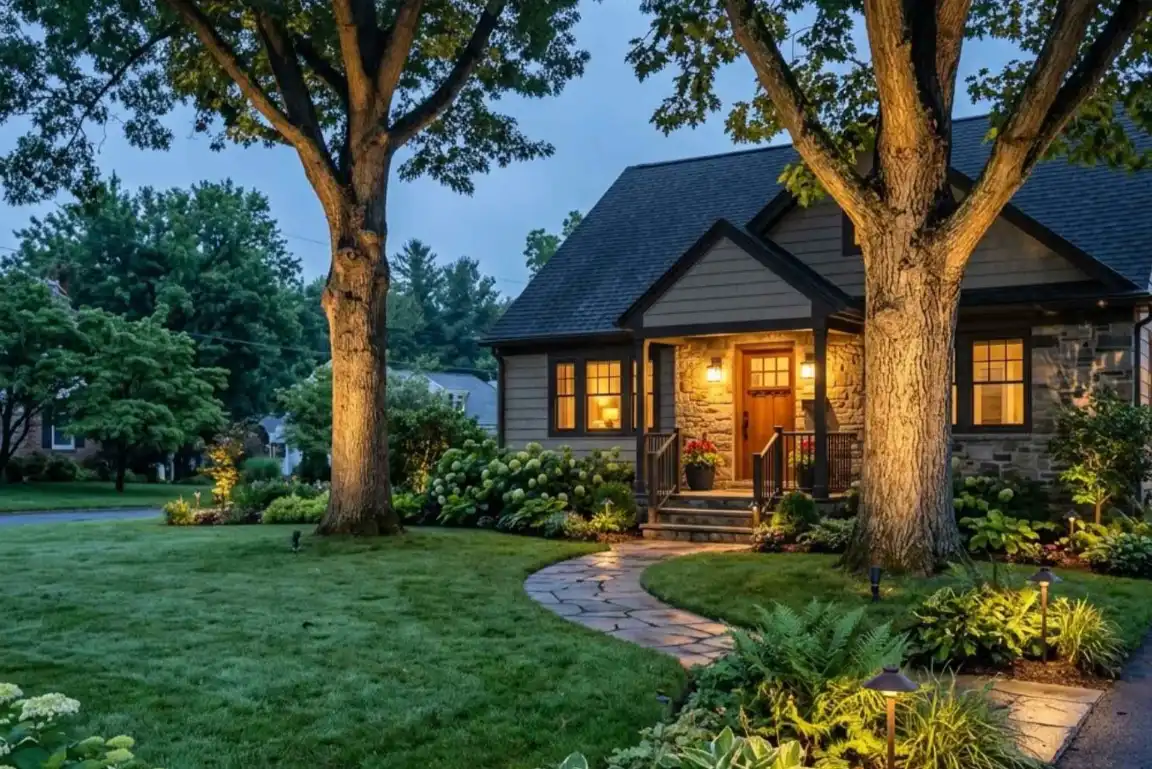
Irrigation and outdoor lighting work together because one grows the yard and the other reveals it. Irrigation keeps turf, beds, and trees healthy through hot, dry summer stretches. Lighting makes that healthy growth visible during the many months when evenings arrive early in Central Pennsylvania. The two systems also share the same few inches of soil, similar smart controls, and the same seasonal service calendar. That overlap is why they perform better as one design than as two separate jobs. This article covers what each system does for the other and which yard features gain from both. It also explains how sprinkler and fixture placement interact, and how one maintenance routine keeps both working.
What Each System Does for the Other
These two systems are often sold separately, but they solve two halves of the same problem. One builds the yard. The other makes sure you actually see it. A company that handles both, like Evergreen Contracting & Irrigation, can design them as a matched pair from the start.
How Irrigation Makes Your Lighting Look Better
Light shows whatever it lands on. Even, healthy turf and full planting beds look rich under a well-aimed fixture. Dry patches and thin edges look worse under light, because a beam pulls the eye straight to them.
This is the part homeowners rarely expect. Lighting is honest. It rewards a well-watered yard and it exposes a struggling one. Irrigation supplies the material that lighting puts on display.
Steady water also keeps plant shapes predictable. Uplighting a shrub or small tree works because the foliage is full and the outline is clean. A plant under water stress thins out, and the same fixture then lights mostly bare branches and mulch.
How Lighting Protects Your Irrigation Investment
For much of the year in Central PA, you get home after the sun has already set. Without lighting, everything your irrigation system keeps green sits in the dark from late afternoon onward. You paid for a healthy yard and then cannot see it.
Lighting also helps you catch irrigation problems sooner. An evening walk past lit beds makes a soggy low spot, a stuck head, or a browning patch easy to notice. Problems found early are cheaper to fix.
Why the Day and Night Cycle Matters in Central Pennsylvania
Our daylight swing is wide, and it shapes how much value each system delivers. Published sun tables for the Harrisburg area put the earliest sunset at about 4:42 p.m. in early December. The shortest day brings roughly nine hours and twenty minutes of daylight. The longest day in late June brings about fifteen hours. That is a swing of nearly five hours and forty five minutes.
Now look at when each system actually runs. Cornell University’s College of Agriculture and Life Sciences recommends watering lawns between 4 a.m. and 8 a.m., so grass dries in the morning sun and turf disease has less chance to take hold. Lighting does its work from dusk onward.
|
Time of Day |
Irrigation |
Outdoor Lighting |
|
Early morning |
Prime watering window | Off at dawn |
| Midday | Watering wastes water to heat and wind |
Off |
|
Dusk to late evening |
System idle | Prime working hours |
| Overnight | Wet grass invites disease |
Low level safety light |
The two systems sit at opposite ends of the clock. They almost never compete for water pressure, power, or your attention. That is a practical reason to run them as one program rather than two.
Which Yard Features Benefit From Both Systems
Some parts of a yard gain from water alone. Others gain from light alone. The features below gain from both, which makes them the natural anchors of a combined design.
|
Yard Feature |
What Irrigation Does |
What Lighting Does |
|
Front lawn |
Keeps color even across the whole area | Washes the surface so the evenness shows |
| Planting beds | Matches water to each plant group |
Adds depth and texture after dark |
|
Specimen tree |
Meets a high water demand at the roots | Becomes the main focal point when uplit |
| Walkway and steps | Keeps bordering plants full and tidy |
Marks edges and cuts trip hazards |
|
Patio and seating area |
Keeps surrounding greenery lush | Extends usable evening hours |
| Front entry | Supports the plantings framing the door |
Improves curb appeal and safety |
Notice the pattern. The features you most want to light are usually the features with the most demanding water needs.
How Your Watering Habits Change What the Lights Reveal
Watering the right way builds a yard that holds up under light. Watering the wrong way builds one that does not.
Penn State Extension explains the failure clearly in its guidance on turfgrass irrigation. Frequent, shallow watering keeps the top layers of soil near saturation most of the time. That encourages shallow roots and weak turf, which is then more open to disease, insects, and traffic damage. Penn State Extension advises watering deeply and waiting until the grass begins to wilt, rather than running the system on a fixed daily habit.
Cornell’s College of Agriculture and Life Sciences puts the general target at about one inch of water per week, including rainfall. That total works best delivered in one or two soakings rather than daily sprinkles.
Deep, less frequent watering builds a tougher yard. Under lighting, that toughness shows as even color and full growth instead of patchy thin spots.
Why Trees and Beds Need Different Water Than Turf
Here is where zoning matters most. Research summarized by the UMass Amherst Center for Agriculture, Food, and the Environment has found that trees and shrubs regularly use more water than turfgrass. One mature oak can carry a water requirement roughly equal to 1,800 square feet of lawn.
That single fact reshapes a combined design. Your uplit specimen tree is both your best lighting feature and one of your thirstiest plants. It should not share a watering zone with open lawn.
Good maintenance pays off here too. The U.S. Environmental Protection Agency points to real savings from upkeep. Homeowners who hire irrigation professionals certified through a WaterSense labeled program for regular maintenance can cut irrigation water use by about 15 percent. That comes to nearly 7,600 gallons a year. Well-planned irrigation services keep those savings going year after year.
How Sprinkler and Fixture Placement Affect Each Other
Both systems live in the top few inches of your soil. They can help each other or fight each other, depending on how they are placed.
Watch these points of contact:
- Spray hitting fixtures. Sprinkler water on a lens leaves mineral spots that dull the light over time. Heads and fixtures should be aimed so they stay out of each other’s way.
- Transformer location. A lighting transformer should sit clear of direct spray and above the splash line, not tucked where a rotor soaks it nightly.
- Shared soil. Digging to repair one system can cut the other. Knowing where both runs sit saves a second repair bill.
- Plant growth. A shrub that fits today can block both spray and light in five years. Layouts should plan for mature size.
Trade coverage in Irrigation and Lighting magazine reflects a practice many installers follow. When an irrigation trench is already open, dropping low-voltage lighting wire in at the same time lowers the risk of damaging either system later. The same professionals stress a hard safety rule. Low-voltage lighting wire and irrigation wire should never be bundled with 120-volt line voltage.
Fixture technology helps as well. The federal ENERGY STAR program notes that incandescent bulbs give off about 90 percent of their energy as heat. LEDs are directional instead, sending light where they are aimed. U.S. Department of Energy guidance adds that LEDs give off very little radiated heat, because the heat they make is pulled into a heat sink in the fixture. Cooler, better-aimed fixtures can sit near foliage with less worry and less wasted spill. That is one reason modern outdoor lighting installation works so well alongside plantings.
Can Both Systems Run on Smart Controls
Yes, and this is where the pairing gets easy to live with. A weather-based irrigation controller adjusts watering to local conditions instead of a fixed clock. Lighting can run on a timer, a dusk-to-dawn sensor, or an app.
Once both are automated, your yard takes care of its own rhythm. Water goes down before sunrise. Lights come up at dusk. You are not out there turning valves or flipping switches. Adding smart lighting systems alongside a smart irrigation controller gives you one simple routine to manage instead of two manual chores.
How One Seasonal Routine Keeps Both Systems Running
Central Pennsylvania freeze and thaw cycles set the calendar for both systems. Water left in pipes over winter can freeze, expand, and crack parts. Fixtures shift as soil heaves and plants grow.
The efficient answer is one seasonal visit that covers both.
|
Season |
Irrigation Task |
Lighting Task |
|
Spring |
Start up the system and check head coverage | Re-aim fixtures as plants leaf out |
| Summer | Adjust run times for heat and rainfall |
Clean lenses and check for spray spotting |
|
Fall |
Drain and winterize before hard freeze | Reset timers for earlier sunset |
| Winter | System stays shut down |
Verify connections after ground heave |
Pairing these tasks saves service calls and keeps small problems from turning into spring surprises. Scheduled seasonal irrigation services make that rhythm simple to keep.
How to Avoid Over-Lighting a Well-Watered Yard
More light is not better light. A yard can be over-lit easily, and the result looks harsh rather than inviting.
DarkSky International advises directing light only where it is needed, which reduces glare and keeps light from spilling where it serves no purpose. In practice that means shielded fixtures, downward aim where possible, warm color tones, and restraint. A few well-placed lights reveal shape and depth. Too many flatten everything into a bright wash and wash out the planting work your irrigation system supports.
Final Thoughts
Irrigation and outdoor lighting improve a Central Pennsylvania yard most when they are treated as one system with two jobs. Water builds even turf, full beds, and healthy trees. Light puts that work on display through the long dark evenings this region gets for much of the year. Deep watering habits and smart zoning around thirsty trees do much of the work. Careful placement keeps spray and fixtures clear of each other, and one seasonal routine ties it all together.
If you want both sides handled by one local team, Evergreen Contracting & Irrigation designs, installs, and services both systems for homes across Central PA. Reach out to schedule a free estimate and see what coordinated irrigation and outdoor lighting can do for your property, day and night.