
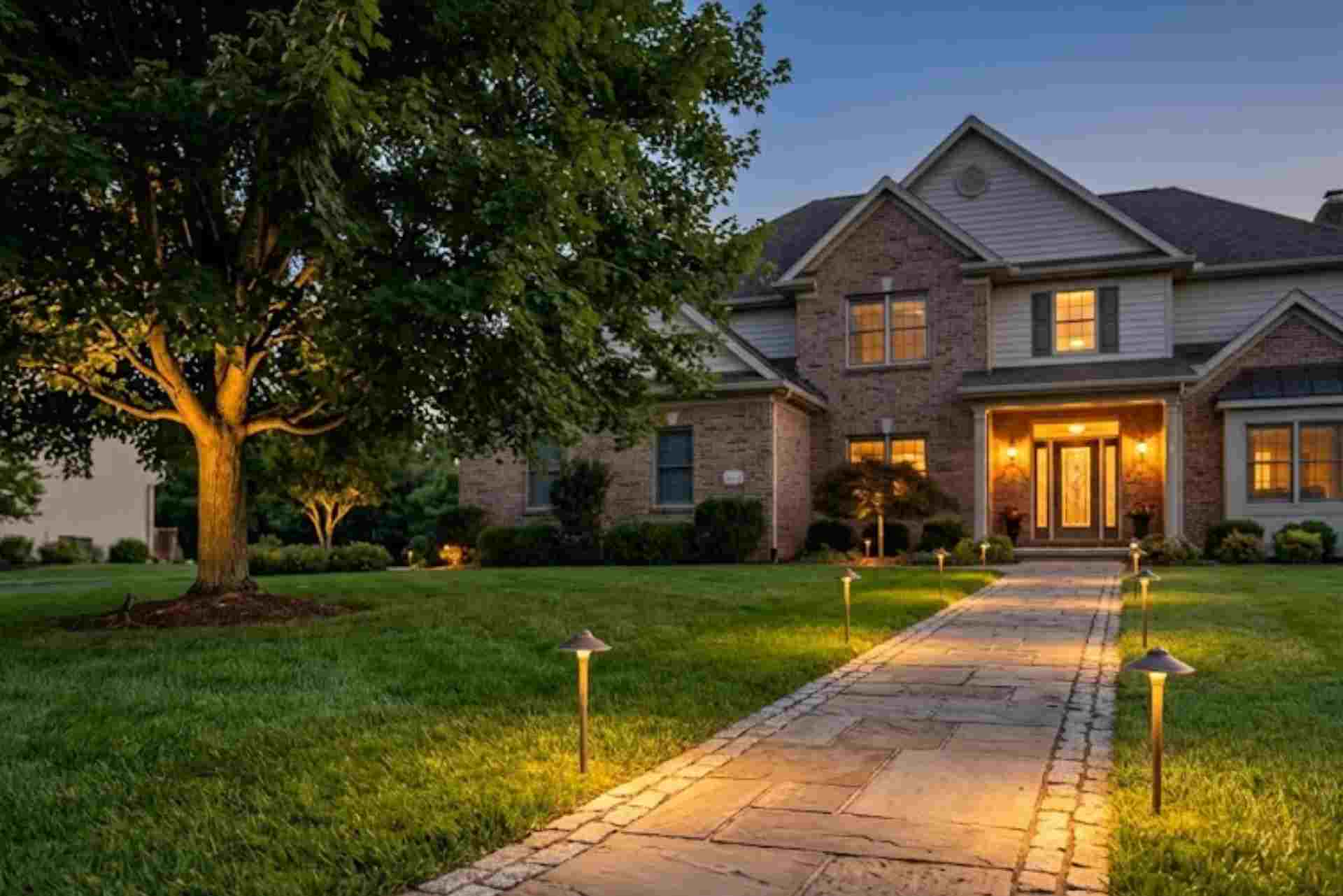
Uniformity creates a strong first impression, not intensity. A lawn that is evenly medium green at a consistent height reads as cared for. A lawn with brilliant green patches next to dry rings reads as neglected, even though parts of it look better. The same rule governs lighting after dark. Six warm fixtures at a single color temperature, aimed so you see the light and not the source, look far better than twenty bright fixtures in mixed colors. Both halves of this come down to consistency, and both are achievable without spending more. Most properties that look wrong at first glance are not underfunded. They are uneven.
This guide covers what specifically creates the impression, on the lawn and after dark, and the mistakes that undo it.
What Actually Creates a Strong First Impression
The eye notices variation before it notices quality. That single fact explains most of what follows.
|
Reads as cared for |
Reads as neglected |
| Even color across the whole lawn |
Bright patches beside dry areas |
|
Consistent mowing height |
Scalped high spots, shaggy low spots |
| Clean, defined bed edges |
Grass creeping into mulch |
|
One light color across the property |
Warm and cool fixtures mixed |
| Light visible, fixture hidden |
Bare bulbs and visible glare |
|
A few well-placed fixtures |
Many fixtures scattered without a plan |
| Concealed wiring |
Cable visible across a bed |
None of the items in the left column require premium materials. They require consistency, which is a design and maintenance question rather than a budget one. That is why a walkthrough with Evergreen Contracting & Irrigation usually starts by looking for what varies rather than what is missing.
Why Even Beats Green
An unevenly watered lawn cannot be fixed with more water.
If one part of a zone receives noticeably less water than another, running the zone longer overwrites the wet area before the dry area catches up. You end up with a lawn that is simultaneously too wet in places and too dry in others, and both conditions are visible.
That evenness is measurable. Irrigation professionals audit it with catch cans, and the resulting figure describes how uniformly a zone applies water. Common causes of poor uniformity are fixable: nozzles the wrong size for the arc, heads spaced too far apart for their radius, pressure too high so water mists and drifts, or heads tilted out of plumb by soil movement.
Three visible symptoms and what they usually mean:
- Rings of dry grass between heads. Spacing or nozzle radius.
- A consistently soggy area near one head. A leak or a tilted head.
- One zone browning while others hold. That zone is oversized for the available flow.
Correcting coverage is ordinary irrigation services work, and it changes appearance more than any amount of additional watering will.
Mowing Height Does More for Appearance Than Most People Think
The lawn half of a first impression is decided by the mower at least as much as by the sprinklers.
Pennsylvania DCNR guidance puts most lawn grasses at 2.5 to 3 inches, noting that this height promotes deep roots that reach nutrients and water and help grass resist pests and tolerate dry weather. Penn State Extension goes further for summer, recommending that heights be raised to three inches or more once summer begins, because taller turf grows thicker and reduces weed pressure.
The reason this matters for appearance is a chain reaction. Penn State Extension describes a direct relationship between mowing height and root depth, with deeper roots letting turf pull water and nutrients from more soil and better withstand heat, drought, disease, and insects. Penn State research photographs show weed infestation increasing sharply as mowing height drops from 2.5 inches to 1.75 to 1 inch.
Four habits that show up visually:
- Follow the one-third rule. Never remove more than a third of the blade in a single cut. Cutting a six inch lawn to two inches stresses it badly and the color change is immediate.
- Keep the blade sharp. A dull blade tears rather than cuts, and torn tips brown within days. This is the most common reason a freshly mowed lawn looks slightly gray.
- Mow dry. Wet grass cuts unevenly and clumps.
- Raise the height in summer. Scalping in July is how a green lawn becomes a brown one.
DCNR notes that mowing generally stops in Pennsylvania around late October when growth stops, with the timing varying by year.
The Edge Line Is What People Read as Care
This is the cheapest improvement available and it is routinely skipped.
A clean edge where turf meets a bed, a walk, or a driveway does more for perceived tidiness than almost anything else, because it is a straight line the eye can follow. Grass creeping over a walkway edge or fading raggedly into mulch reads as neglect regardless of how healthy the turf is.
Worth attending to: bed lines, driveway and walk edges, tree rings, and the strip along a fence. A defined edge also gives sprinkler heads a logical place to sit, back from the hard surface where they will not overspray onto concrete.
Evening Lighting Is a Different Discipline
Lighting a property well is composition, not illumination. The goal is not to make things visible. It is to decide what people look at.
Good outdoor lighting works in three layers:
- Path and step lighting for safe movement, low to the ground and modest in output.
- Accent lighting aimed at specific features, meaning a specimen tree, a stone facade, a column, or an entry.
- Ambient or wash lighting that fills space softly so the lit features do not float in blackness.
A property with only path lights looks like a runway. A property with only uplights looks theatrical and hard to walk through. The combination is what reads as designed.
Restraint matters more than coverage. Choose two or three features genuinely worth attention and light those well, then leave the rest dim. A composition where everything is lit has no focal point, which is the same as having no composition. That editing decision is the heart of outdoor lighting design and installation, and it is what separates a designed property from one with fixtures on it.
Color Temperature Is the Single Biggest Tell
If one technical choice separates professional-looking lighting from amateur, it is this one.
Color temperature is measured in Kelvin. Lower numbers look warm and golden. Higher numbers look cool and blue. For residential outdoor lighting, the accepted range is 2700K to 3000K. At 2700K the light resembles traditional incandescent and reads as inviting. At 3000K it is slightly crisper, which some prefer for facades and paths.
Above 4000K, light reads as institutional. It makes brick look gray, foliage look sickly, and a house looks like a parking area rather than a home.
The more important rule is consistency. Mixing color temperatures within the same sightline is the most visible sign of a piecemeal or self-installed system, because the eye immediately catches one fixture reading yellow next to another reading blue. Choosing between 2700K and 3000K matters far less than picking one and using it everywhere.
Two practical notes. Replacement lamps bought over the years drift in color unless you record the specification. And inexpensive fixtures can shift color as they age, so a system that started consistent may not stay that way.
See the Light, Not the Fixture
The professional standard is that a viewer notices the effect and never the source.
What that requires:
- Conceal the fixture. Tuck uplights behind shrubs, recess well lights into groundcover, screen spotlights with foliage or stonework.
- Keep sources below eye level where possible. Path lights in the 18 to 24 inch range stay under normal sight lines.
- Use shields, hoods, or louvers to direct light down and keep it out of sight. Many quality fixtures include adjustable shields.
- Aim away from windows. Both yours and your neighbors’.
- Bury the wire. Cable visible across a bed undoes an otherwise good installation.
Glare is the failure mode. A fixture you can look straight into creates discomfort and destroys the effect it was installed to produce, because a bright point in the visual field makes everything around it read as darker. When fixtures shift out of aim or lens cloud, the composition degrades quietly, which is why periodic lighting service and repair matters more on lighting than most people expect.
The Most Common Mistake Is Too Much Light
Over-lighting is more common than under-lighting and harder to undo.
The failure looks like this: every wall washed, every tree lit, every path edged in bright fixtures. The result is flat, harsh, and oddly unwelcoming, because contrast is what creates depth. Without dark areas, lit areas have nothing to be brighter than.
Restraint reads as expensive. A dim, warm property with three beautifully lit features looks considered. A uniformly bright one looks like security lighting.
If a system already feels too bright, the fixes are inexpensive: remove fixtures rather than add them, swap to lower output lamps, add shields, and aim more carefully.
What Changes in Central Pennsylvania Specifically
Local conditions shift both halves of this.
Summer dormancy is normal here. Penn State Extension notes that cool-season grasses, which include the Kentucky bluegrass, ryegrass, and fescues used across this state, can go semi-dormant during hot or dry periods. A lawn browning in a dry August is behaving normally, and even browning looks far better than patchy browning.
Drought conditions are a live constraint. Much of the service area has been under drought watch or warning through this summer, which affects how much watering is reasonable and makes even coverage matter more, since you have less water to work with.
Darkness arrives early for half the year. From October through March, most arrivals home happen after dark. Lighting is not a summer amenity here, it is what the property looks like during the months when nobody sees the lawn at all.
Snow changes everything. Snow reflects light and brightens a scene considerably, so a system tuned for summer can read as harsh in January. Fixtures also get buried and struck by plows.
Conditions vary across the lawn irrigation service areas of Dauphin, Cumberland, Lancaster, Lebanon, York, and Perry counties, between valley clay and ridge properties, which changes both what a lawn will do and where fixtures survive.
A Sequence That Works
If you are starting from a property that looks tired, order matters.
- Fix coverage first. Even watering is the foundation. Nothing else compensates for it.
- Correct the mowing. Raise the height, sharpen the blade, follow the one-third rule. Costs nothing.
- Define the edges. A weekend of edging changes more than most purchases.
- Repair what is broken before adding anything new, on both systems.
- Then light selectively. Choose two or three features. Resist lighting everything.
- Standardize color temperature across every fixture, including replacements.
Steps one through four cost the least and change the most. Step five is where a property goes from tidy to memorable. Getting the underlying coverage right during sprinkler system installation is what makes the rest of the sequence possible, because a lawn that waters unevenly will undo every other effort.
Final Thoughts
A strong first impression comes from consistency rather than intensity. Even color across the lawn beats brighter color in patches. One warm color temperature across the property beats more fixtures in mixed tones.
On the lawn, the levers are even water coverage, a mowing height of roughly 2.5 to 3 inches rising toward three or more in summer per Penn State Extension and DCNR guidance, a sharp blade, the one-third rule, and clean edges.
After dark, the levers are three layers of light, a single color temperature in the 2700K to 3000K range, hidden fixtures with controlled glare, and the discipline to light two or three things rather than everything.
Almost none of that is a spending decision. It is a consistency decision, which is why a property can look considerably better within one season without a major project.
If you want the coverage assessed and a lighting plan built around a few genuine focal points rather than blanket illumination, ask about outdoor lighting and irrigation in Central Pennsylvania. A useful visit will identify what is uneven before it recommends anything new.